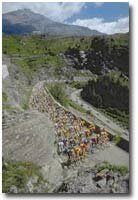
 When cycling you will invariably encounter a hill, or mountain, that must be ascended. If you are a racing cyclist, you will know this is often where races are won and lost.
For some the experience of riding up a hill will be one of elation but for most, the pain of climbing has been enough to see the bike sent to the darkest recesses of the shed or garage and the reintroduction of tiddly-winks to the daily activities.
The simplest way of improving your hill climbing is to incorporate hills in all or most of your rides. Avoiding hills will not improve your ability to climb them.
The experience of climbing hills shouldn't defeat anyone because through the use of proper technique, even the mountain pass will become a challenge rather than a dread.
If you decide to include hills in your training rides there are several variables to be considered when climbing
Gear Shifting
Do not down shift too soon as this will lose you valuable momentum. When this happens you end up having to work harder to regain your lost momentum and this puts your legs under unnecessary strain right from the outset.
Conversely, do not shift too late as this also will result in a waste of energy by pushing too large a gear.
The idea with gearing and shifting is to maintain a "comfortable cadence", shifting when you become uncomfortable and your rate of pedalling drops, but before you bog down and have to horse the gear.
Some top cyclists recommend a cadence of around 80 RPM and shifting up to a higher gear as you near the top. However others prefer climbing at a lower cadence, noting that the higher the cadence the more oxygen you will consume.
 This was backed up by an article in "Medicine and Science in Sports and Exercise" that found that "maximum sustainable power to be greater at 60 RPM than at 100 RPM, and blood lactate responses to be greater at the higher RPMs".
Standing and sitting
The second variable to climbing involves the decision to climb out of the saddle or in it and the positioning of your body for both of these techniques.
A simple rule to start with is that if the hill is long, climb in the saddle. If the hill is short, stand up. Often it becomes a matter of preference as well as what you as an individual feel more efficient at. I once saw Veronque climb a mountain in the Tour de France standing up all the way.
A specific note here is that even if the hill is a long one, standing occasionally is recommended as this stretches your back, increases your momentum and shifts the strain from certain muscle groups allowing them to rest for a short while before continuing the climb in the saddle. Often whilst training on long hills I will alternate 20 pedal strokes seated, then 20 standing up and so on.
Climbing techniques in the saddle.
For the small framed cyclist, sliding back on your saddle helps you generate more force through the top of your pedal stroke, also throughout the down stroke and when pulling up on the pedal.
Your hands can be either on the top of your brake hoods, or the top of your handlebars but keep them relaxed and periodically change their position.
Your upper body should not be crunched up and your shoulders should be open to allow your lungs and diaphragm to open easily and therefore aid breathing. A relaxed upper body is beneficial as any muscle tension increases your oxygen and caloric demands.
 If you are a tall cyclist you will benefit from sliding to the front of your saddle, therefore positioning your hips more over the cranks. This gives you more leverage.
In general, climbing in the saddle requires less energy, uses less oxygen and is done at lower heart rates. However there are times when you have to stand, what we refer to as "honking".
Climbing techniques out of the saddle.
The need to get out of the saddle usually happens when the gradient of the hill you are climbing increases, or if muscles fatigue, the climb is short (often referred to as sprinters hills), or an increase in power is needed to crest the hill or drop a fellow rider.
Getting out of the saddle should be done on the down stroke. This minimizes the loss of momentum. You can usually shift to a larger gear before standing.
Your weight should be over your cranks to maximize power during the pedal stroke. This means that you should not lean too far forward or place too much of your bodyweight on the handlebars. Infact keep a relaxed hold on the bars with your hands on the brake hoods.
As above keep your shoulders and torso open to allow for easier breathing.
Bouncing on your pedals is not advisable. Think of running on the pedals and establish a smooth rhythm concentrating on pedalling in circles.
Finally with both forms of climbing, breathing rate will naturally increase and establishing a breathing rhythm will help this increased demand for oxygen. You must fight against the fact that often when an increase in intensity is called for a person will more likely hold their breath. Work on maintaining a rhythm with your focus on breathing out to rid the body of CO2 and relax on the inspiration. You'll be pleased to know that if you relax, your body will create it's own breathing rhythm.