|
 The most common mistake made in cycling, and training for cycling, especially among casual cyclists is to push too big a gear, too slowly. You see cyclists plodding along with very slow leg movement. Everyone should learn to spin their pedals. For several reasons spinning, or a high cadence which is the term used to describe the rate of spinning in rpm, is the key to fitness and specifically to increasing aerobic fitness. The most common mistake made in cycling, and training for cycling, especially among casual cyclists is to push too big a gear, too slowly. You see cyclists plodding along with very slow leg movement. Everyone should learn to spin their pedals. For several reasons spinning, or a high cadence which is the term used to describe the rate of spinning in rpm, is the key to fitness and specifically to increasing aerobic fitness.
First, we have what we call the muscle pump. When you contract a muscle, the muscle cells shorten and get fatter. When they get fatter, they put pressure on surrounding blood vessels forcing the blood out of them and towards the heart in a forward direction. This accelerates the flow of blood through the body while decreasing the workload on the heart, if the contractions are short and fast. If the contractions are significantly longer, this causes a backpressure against the heart forcing the heart to work harder and slowing the blood flow through the body. This backpressure is OK for the short distances a racer may need to make a break, jump a gap or chase a group but work against you for the longer distances.
Second, it is easier to control your speed and keep it smooth and steady when you spin. Pushing too big a gear does not provide a good feel for your speed and your speed subsequently fluctuates up and down which beats up your legs very quickly. Spinning will also improve your bike control.
It is generally thought that a cadence, the rate of spinning, should be between 80-100 rpm. In research carried out on Russian cyclists they found that the optimum cadence is 92 rpm. It probably applies to cyclists even if you are not Russian!
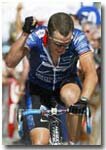
One of the greatest exponents of spinning at a high cadence, even whilst climbing mountains, is shown top right. The American Lance Armstrong, multiple winner of the Tour de France.
|