|
The pneumatic tyre and the chain drive, followed by the development of gears, revolutionised cycling in the late 1800s. IOver the past 15 years, there has been a revolution in the development and use of new materials for building cycle frames. It wasn't that long ago that frames were made out of cast iron or even wood. Today cycles are made out of exotic materials such as titanium, aluminum, and carbon fibre. Bicycle frames in the 2000's are lighter and stronger than ever before.
 Swiftwalkers Swiftwalkers
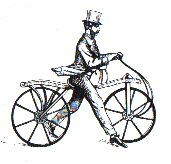
German Inventor Karl von Drais is credited with developing the first bicycle. His machine, known as the "swiftwalker," hit the road in 1817. This early bicycle had no pedals, and its frame was a wooden beam. The device had two wooden wheels with iron rims and leather-covered tyres. As the name suggests, a rider walked on top of the bike with his feet leaving the ground during descents.
Age of the Velocipedes
While it might seem simple and obvious now, getting the rider's feet completely off the ground was a major stumbling block in the development of the cycle. The rider used pedal-cranks attached to the hub of a wheel to propel himself. There is a dispute as to who invented the machine that became known as the "velocipede," but there is no question as to its impact.
The velocipedes of the mid 1800s consisted of two wooden tyres, a front fork, handlebars for steering, a saddle on wooden frame, and pedals on the axle of the front wheel. The velocipede also received a nickname, the "boneshaker." With the rider now completely mounted on the bicycle, he felt all of the bumps--the early velocipedes were not equipped for absorbing vibrations. It wasn't until the development of the pneumatic tyre that this problem was effectively addressed. At around the same time the pneumatic tyre was developed (1888), lighter materials began to be used for frames, improving the ride dramatically.
Materials for Frames
By the time the modern "safety" cycle was developed in the late 1800s most frames were made with steel tubing instead of wood or cast iron. While the steel cycles were quite strong they were also very heavy. It was not uncommon for a cycle of that era to weigh in at over 80 pounds (36.28 kg.), take heed all you weight freaks.
Steel frames are still used today, but the tubing has thinner walls and weighs considerably less. Modern frame makers use steel, aluminum, titanium, and even carbon-fibre. Which material they use depends on the type of bike, the rider's preference, and the cost.
Steel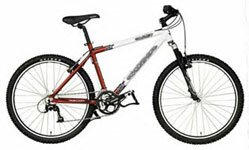
Steel has been around a long time. It's probably the most researched, well known, and the most used material in just about every industry. It's the most tunable, in the sense that if you want to tune a frame the way someone tunes a piano, you have a really great selection of tubes that you can select from. Steel is also generally the most affordable of the materials listed here.
Aluminum
Aluminum is an interesting material. You can't really let it flex, because the more it gets to bend the quicker it reaches the end of its life. That's why you see a lot of aluminum frames today that have very large diameter tubing. That's to limit the flexing that happens as you ride the bike.
Titanium
It seems that titanium is the material of choice. It has a great strength-to-weight ratio. You don't need to paint it and it looks good over a long period of time. It has forgiving qualities when it collides with other things, it tends to return to its original shape. The cost however is another matter, titanium tubing can cost up to 15 times more than steel. 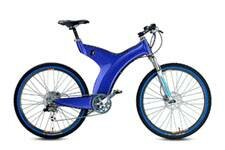
Carbon-Fibre
Unlike the other materials, where you have to draw it into a tube or forge it into a section, with carbon you can literally change the direction of the fabric in a certain area which will affect the way a load comes through that area.
Yield and Ultimate Strength
One way to compare materials is to look at their yield and ultimate strength e.g. when you bend a plastic comb to a point then let go, it will return to its original form. Then there is a point where you bend it and it keeps the shape you've bent it into. Then there's a point where it actually breaks."
These three modes for comparison of materials are quite important because they affect how a frame is designed. The most visible example of this is the large tubing one sees on aluminum bicycles. The yield and ultimate strength of aluminum are quite close. This means that if the cycle is subjected to strong forces, the point at which it will bend is very close to the point at which it would fail completely. The large size tubing is stronger than its smaller counterparts and keeps the bike from flexing or bending.
Yield Strength, Ultimate Strength, and Elasticity Activity
When a frame maker chooses a material to make a frame, he or she usually considers the following properties of the material.
Elasticity: When an object responds to bending or stretching by returning to its original shape, it is said to have a high level of elasticity. A material which bends and then holds the bent shape has very little elasticity.
Yield Strength: This is the amount of force needed to bend a material to a point where it cannot return to its original shape.
Ultimate Strength: This is the amount of force needed to break a material. This is the point at which a cycle frame breaks, usually with dangerous consequences for the rider.
next
|